
🎁 30% off your first order with code BIENVENUE30 · free shipping · 30-day money-back guarantee.
A Japanese knife slices a tomato without pressure, but only while the edge is keen. Good news: sharpening is not just for professionals. Here is the method, the angles to aim for and the mistakes that ruin a blade.
Honing or sharpening? Honing rod or whetstone?
- A honing rod (honing steel) realigns an edge that has bent with use. It removes almost no metal. Use it often, on blades that are not too hard.
- A whetstone (sharpening) removes metal and creates a new edge. Use it when the knife no longer cuts even after honing.
Careful: very hard or asymmetric Japanese blades do not like a metal honing rod. Use a whetstone, or a sharpener designed for them.
What angle for a Japanese knife?
Japanese knives have a finer edge than European ones: aim for 10 to 15° per side, against 15 to 20° for a European knife. If in doubt, 15° is a good starting point. What matters most is to hold the same angle throughout each stroke.
Which stone to choose?
- 1000 grit: to bring back an edge on a dull knife.
- 3000 to 6000 grit: to refine and get a clean edge.
- Double-sided 1000/3000 stone: the best choice to start with.
The method in 6 steps
- Soak the stone for 10 to 15 minutes if it needs soaking, and set it on a non-slip base.
- Place the heel of the blade on the stone at about 15°.
- Push the blade forward, heel to tip, with light, even pressure.
- Repeat 8 to 10 times on one side, until you feel a slight burr (a thin wire edge) on the other side.
- Flip and make a few strokes on the other side.
- Rinse, dry and test on a sheet of paper or a tomato.
What if you don't want a stone?
A stone takes some practice. If you are starting out, a rolling sharpener with an angle guide holds the angle for you. Our TitaniumSharpener offers two angles (15° and 20°), a diamond stone and a magnetic holder that grips the knife. From €24.99.
For a very hard or valuable blade, a whetstone remains the reference. For everyday use, the roller does the job well.
Mistakes that ruin a blade
- Changing the angle during a stroke.
- Pressing too hard: you round the edge instead of refining it.
- Sharpening a dirty or greasy knife.
- Using a honing rod on a very hard Japanese blade.
- Cutting on glass, stone or ceramic: the edge dulls very quickly.
How often?
Depending on use, a pass on a stone or roller every 1 to 3 months in a home kitchen, and a light touch on the honing rod before big prep sessions if your blade can take it. A knife that no longer bites into tomato skin needs sharpening.
The surface matters too: on a board that is too hard, the edge wears faster. Read our analysis: titanium cutting boards and knives: the truth.
A good knife helps too
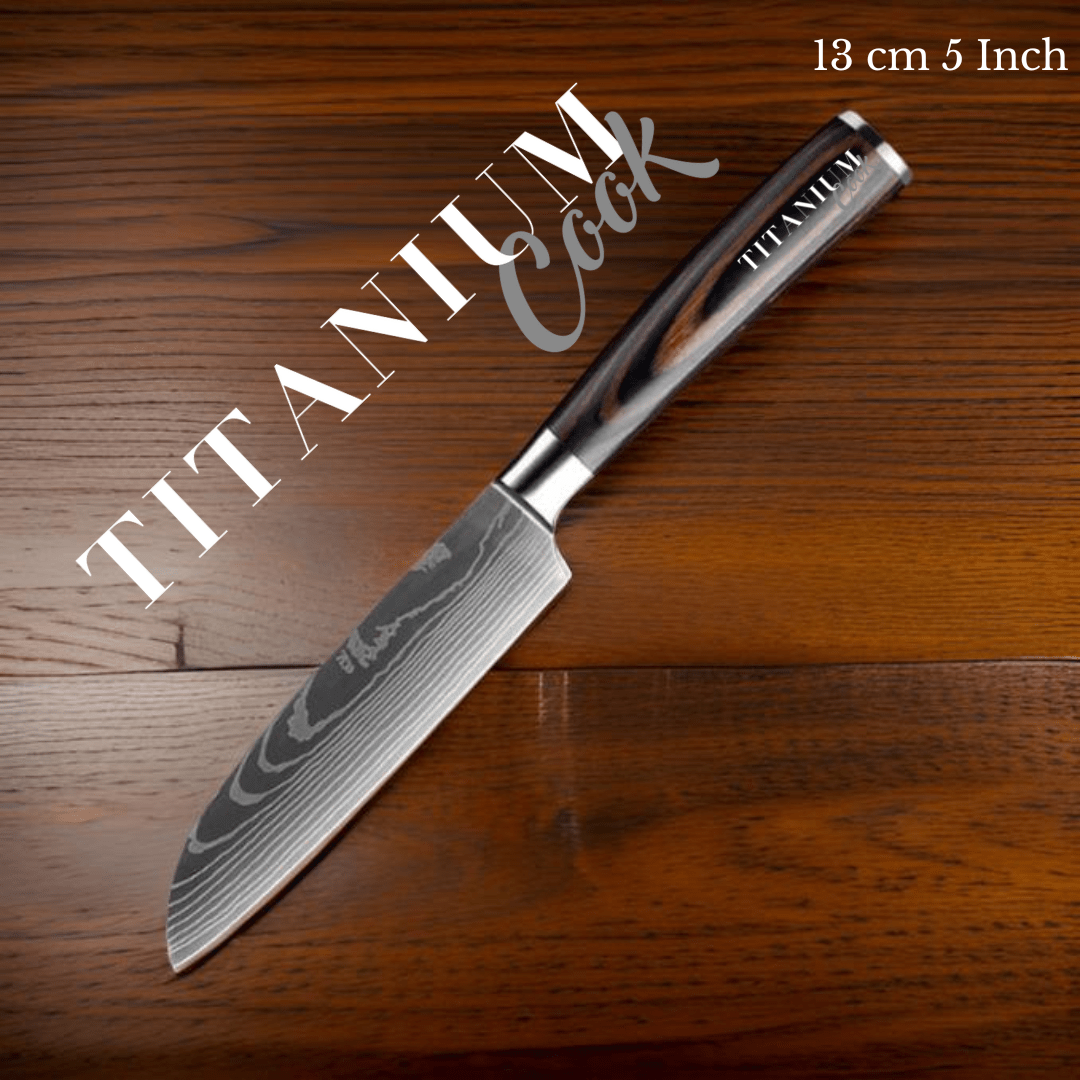
Our Japanese knives (santoku, chef, nakiri, sets) are made for daily cutting. Not sure which one? Our guide: which Japanese knife to choose.
👉 Discover the TitaniumSharpener · code BIENVENUE30: 30% off your first order.
FAQ
What angle for a Japanese knife?
10 to 15° per side. If in doubt, 15°.
Is a honing rod suitable for a Japanese knife?
Not for very hard or asymmetric blades. For the others, a light honing rod keeps the edge in shape but does not replace the stone.
Does a rolling sharpener damage the knife?
Not if used gently at the right angle. It removes metal like a stone does, so go without force.
Should I sharpen a new knife?
No. A new knife arrives sharp; you sharpen when it loses its bite.
🚚 Free shipping · ↩️ 30-day money-back guarantee · 🎁 BIENVENUE30: 30% off your first order.

Leave a comment
This site is protected by hCaptcha and the hCaptcha Privacy Policy and Terms of Service apply.